

Eligibility Criteria
- MBBS Graduates
- Practicing Doctors (MBBS+MD/MS/M.Ch)
- MBBS+MD And DNB Residents
- Undergraduate Medical Students In The Final Year
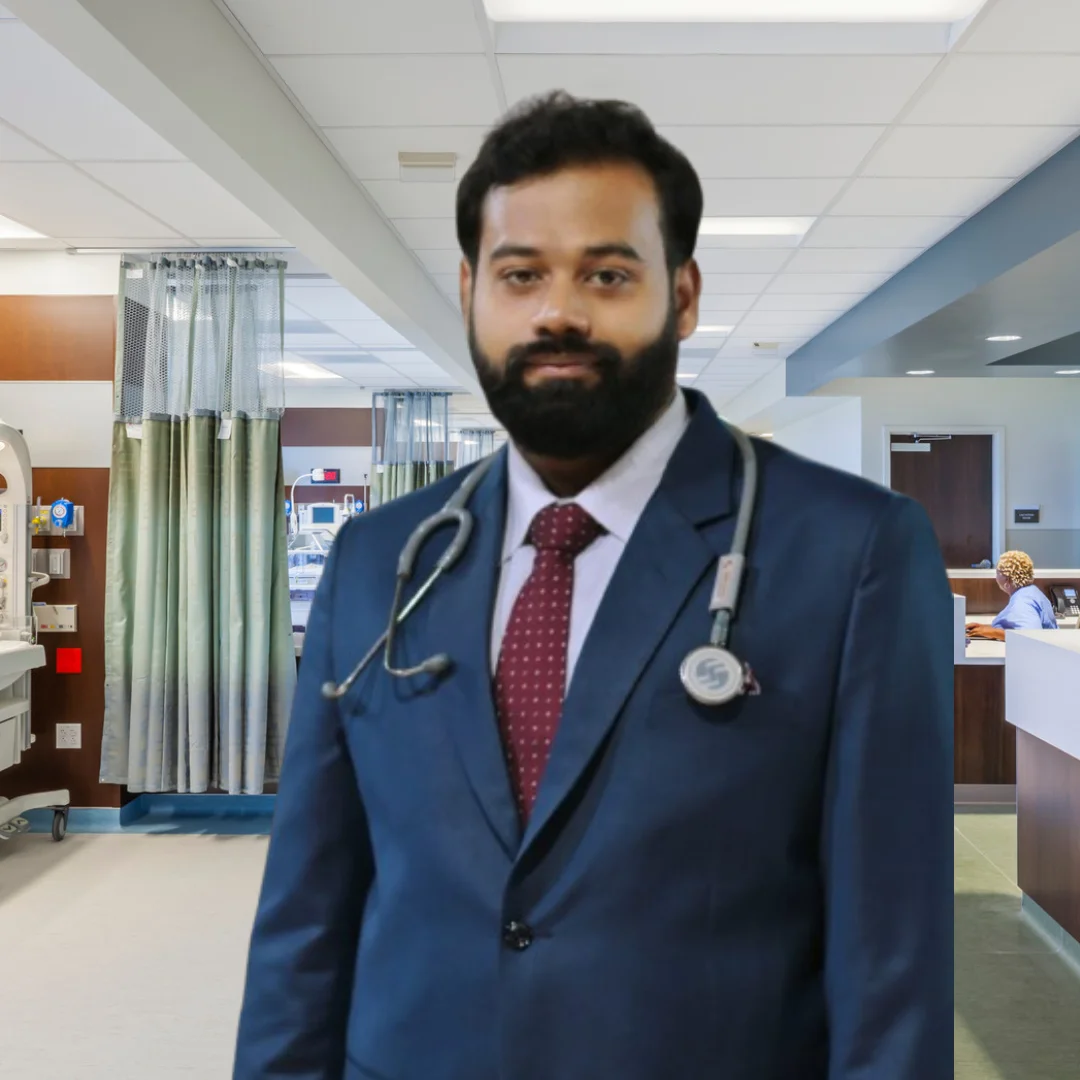
Dr. Soumya Banerjee
MBBS (Cal) , MS (General and Laparoscopic Surgery)
Fellowship in Gastroenterology
Fellowship in Gastroenterology is a 12-month clinical fellowship designed for MBBS doctors seeking specialized observership, in the diagnosis and management of gastrointestinal, liver, pancreatic, and digestive disorders. The program combines online academic learning with clinical observership, enabling participants to strengthen their practical skills and advance their clinical careers.
- 12months
- Oct 20, 2026
- 11 modules
- 120 CPD Points
- Mode - Hybrid
- Observership - 1 Month
Course Curriculum
1. Gastroenterology
History-taking and physical examination in gastroenterology
Endoscopic procedures (esophagogastroduodenoscopy, colonoscopy, flexible sigmoidoscopy)
Endoscopic retrograde cholangiopancreatography (ERCP)
Endoscopic ultrasound (EUS)
Capsule endoscopy
2. Hepatology
Liver anatomy and physiology
Hepatitis (viral and non-viral)
Cirrhosis and complications
Liver transplantation
Liver biopsy interpretation
3. Inflammatory Bowel Disease (IBD)
Crohn’s disease
Ulcerative colitis
Indeterminate colitis
Medical and surgical management
4. Functional Gastrointestinal Disorders
Irritable bowel syndrome (IBS)
Functional dyspepsia
Gastrointestinal motility disorders
5. Gastrointestinal Oncology
Colorectal cancer
Esophageal cancer
Gastric cancer
Pancreatic cancer
Gastrointestinal Bleeding
Upper and lower GI bleeding
Endoscopic hemostasis techniques
Evaluation and management of anemia
Nutrition in Gastroenterology:
Nutritional assessment
Enteral and parenteral nutrition
Malabsorption syndromes
Motility Disorders:
Achalasia
Gastroparesis
Small intestinal dysmotility
6. Advanced Endoscopic Procedures
Endoscopic mucosal resection (EMR)
Endoscopic submucosal dissection (ESD)
Stenting procedures
7. Pancreaticobiliary Disorders
Pancreatitis
Pancreatic cysts
Biliary stones and strictures
Research and Academic Development
8. Research Methodology
Data interpretation
Journal club participation
Quality Improvement and Patient Safety:
Continuous quality improvement
Patient safety initiatives
Risk management
9. Surgical Gastroenterology
Introduction to Infections and Antibiotics in GI Surgery
Overview of common infections in gastrointestinal surgery
Principles of antibiotic use in surgical practice
Prophylactic antibiotic strategies
10. Basics of Esophagus, Pancreas, Liver, Spleen & Colon
Anatomy and physiology of the esophagus
Benign and malignant esophageal diseases
Surgical techniques for esophageal resection
Complications and their management
Pancreas
Anatomy and function of the pancreas
Surgical management of pancreatic tumors
Islet and pancreas transplantation
Complications of pancreatic surgery
Liver
Hepatic anatomy and physiology
Indications and techniques for liver resection
Liver transplantation procedures
Management of liver tumors
Spleen
Surgical considerations for splenic disorders
Splenectomy techniques and indications
Preservation of splenic function
Colon
Colorectal anatomy and physiology
Surgical management of colorectal cancer
Inflammatory bowel disease and surgical options
Complications and postoperative care
11. Videos: Minimal Invasive Esophagectomy
Review and analysis of minimal invasive esophagectomy procedures
Case discussions and surgical decision-making
Videos: Procedures for Esophageal Replacement
Evaluation of surgical techniques for esophageal replacement
Case presentations and discussions
Videos: Carcinoma of the Stomach
Detailed analysis of surgical interventions for stomach cancer
Video demonstrations and case discussions
Videos: Visceral Artery Aneurysms
Understanding and managing visceral artery aneurysms surgically
Video presentations and case reviews
Videos: Gastrointestinal Tumors
In-depth analysis of surgical approaches to gastrointestinal tumors
Video-based learning and case discussions
Videos: Islet and Pancreas Transplantation
Review of surgical techniques for islet and pancreas transplantation
Video demonstrations and case studies
Videos: Choledochal Cyst
Evaluation and surgical management of choledochal cysts
Video presentations and case reviews
Videos: Liver Transplantation
Comprehensive review of liver transplantation procedures
Video-based learning and case discussions
Earn Recognized Certifications
Upon successful completion of the course and all required assessments, participants will be awarded professional certificates that are recognized by leading healthcare institutions.
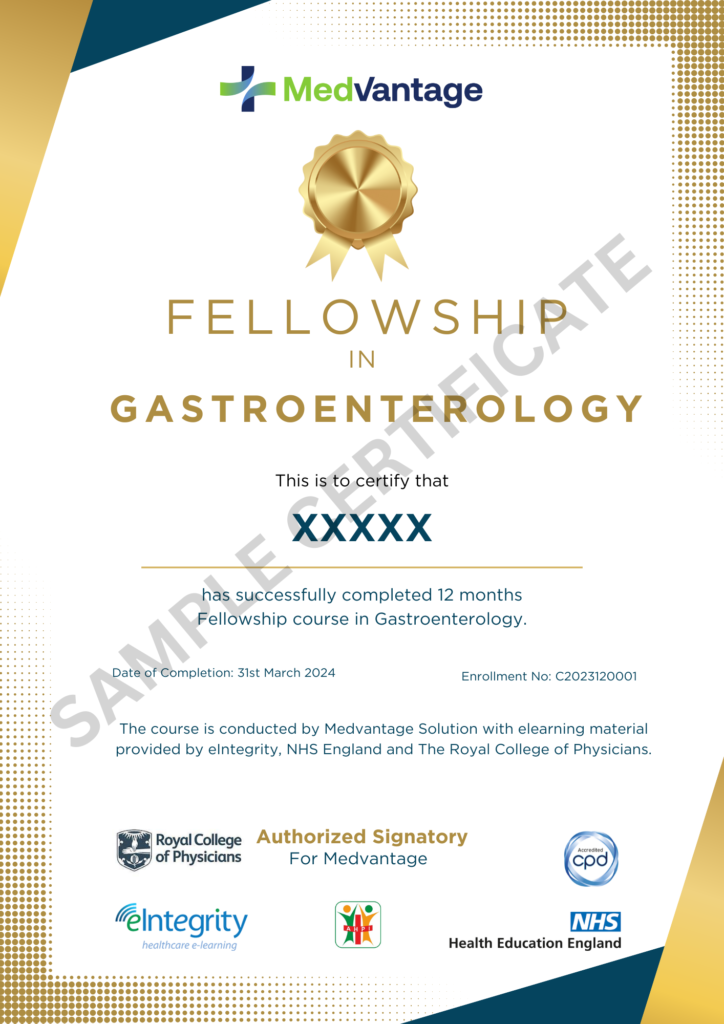
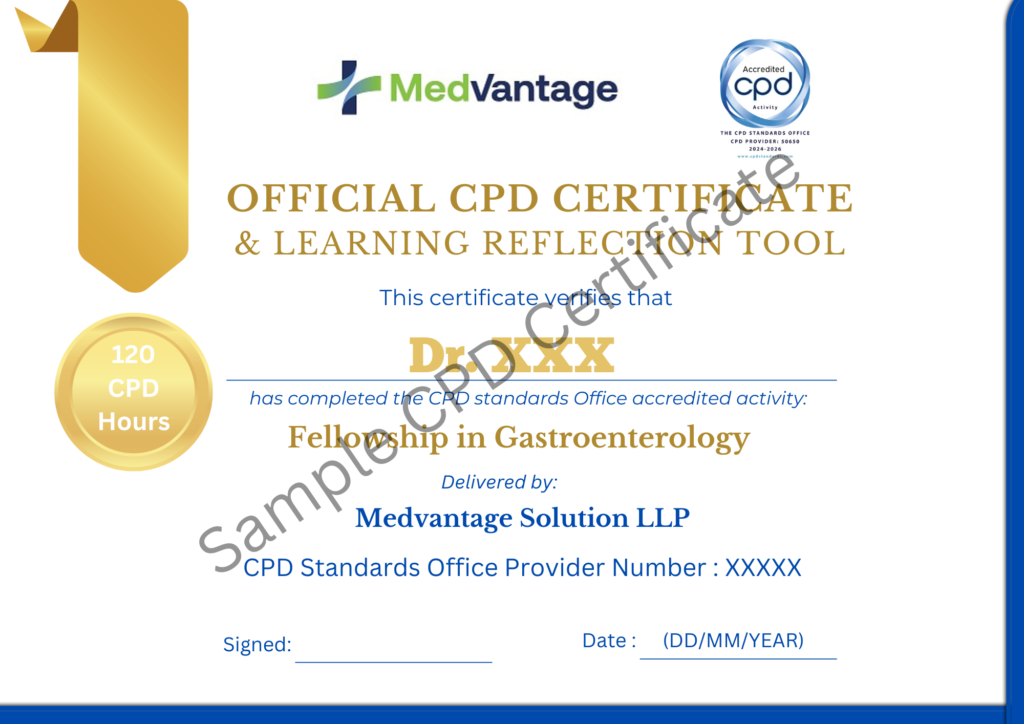
- Earn 120 CPD Points continuing medical education credits
- Digital certification with secure verification
- Share your achievement directly on LinkedIn and other platforms
- Certificate issued by MedVantage Education and recognized industry partners
Frequently Asked Questions
What is the duration of Fellowship in Gastroenterology by Medvantage
The Fellowship in Gastroenterology by MedVantage is a 12-month hybrid program designed for working medical professionals. The course includes 11 comprehensive learning modules, 120 CPD points, and 1 month of clinical observership at a reputed hospital, providing a balanced blend of online academic learning and clinical exposure.
What is the eligibility to enroll in the Fellowship in Gastroenterology?
The Fellowship in Gastroenterology by Medvantage is open to healthcare professionals at different stages of their medical careers. You are eligible to enroll if you are:
- MBBS Graduate
- Practicing Doctor (MBBS, MD/MS/M.Ch)
- MD or DNB Resident
- Final-Year MBBS Student
Can I persue this course if I am in final year?
YES, this course can be taken up by final year, graduated & post graduate students.
What’s the importance of this course in India?
You will get additional qualification Certificate (United Kingdom) which will benefit you in increasing the number of patients in OPD.
How many CPD hours are accredited on completion of the Fellowship in Gastroenterology?
Upon the successful completion of the Fellowship in Gastroenterology, participants are awarded 120 CPD (Continuing Professional Development) hours by the CPD Standards Office, United Kingdom.
Can I pursue the course if I’m working in govt. hospital?
YES, it’s an online course, you can attend classes at any time as per your schedule.
Can I apply if my FMGE is not clear?
YES, you can apply, but by end of the course we need your MCI registration certificate.
In which form, I will get the study material?
In form of modules which includes Live Class with Course Mentor, Recorded Lectures, Webinars and PDFs.
Can international students enroll in the Fellowship in Gastroenterology?
Yes. International students are welcome to enroll in the Fellowship in Gastroenterology by Medvantage, subject to meeting the program's eligibility criteria and submission of the required academic and professional documents.