


Eligibility Criteria
- MBBS/BDS/AYUSH/Nursing & Other Healthcare Graduates
- Practicing Doctors
- MD And DNB Residents
- Undergraduate Medical Students In The Final Year

Dr. Ramkesh Singh Parmar
GOLD MEDALIST MBBS, MD (INTERNAL MEDICINE)
SMS MEDICAL COLLEGE JAIPUR DNB, FNB I D, FICP, FISH, FISC, FIDM, FIDF, FELLOW OF AMERICAN COLLEGE OF PHYSICIANS, FELLOW AMERICAN COLLEGE OF CLINICAL ENDOCRINOLOGY, FELLOW ROYAL COLLEGE OF PHYSICIANS OF ENGLAND, PHD, DIABETES, THYROID & ENDOCRINOLOGY
Advance Certificate In Internal Medicine
The Advance Certificate In Internal Medicine is designed to equip healthcare practitioners for specialized medical care roles in high-stakes healthcare settings such as emergency rooms, intensive care units, and disaster response situations.. Under the guidance of experienced intensivists, it enhances efficiency, elevates the quality of care, and ultimately leads to improved patient outcomes. Further more, the program includes valuable medical relevance and practical applicability in the healthcare field.
- 06 Months
- Sep 29, 2026
- 18 modules
- 80 CPD Points
- Mode - Online
Course Curriculum
1. Basics in Clinical Medicine
Introduction to General Considerations in Clinical Medicine
General Assessment of the Patient
Ethical Principles
Preoperative Evaluation and Perioperative Management
2. Pain & Symptom Assessment
Multidimensional pain assessment
Pharmacological interventions
Non-pharmacological approaches
Management of common symptoms – nausea, dyspnea, fatigue
Basics In Patient Assessment
3. Basics In Patient Assessment
Essentials for Internal Medicine Physician
Emergency Design and Staffing
Wound Assessment and Management
Local and Regional Anesthesia
Point of Care Testing
Essentials of Medicolegal Case Writing
Medicolegal Issues in Emergency
Patient Safety and Quality in Internal Department
4. Critical Care Essentials
Standards of Care during Air Transfer
Standards of Care during Road Transfer
Management of Cardiac Arrest in Adults
Airway Management
Management of Critically Ill Patient in Internal Medicine
Overview of Shock
Sepsis and Septic Shock
Noninvasive Ventilation
Mechanical Ventilation
Oxygen Therapy
5. Respiratory & Pulmonology Disorders
Hemoptysis
Acute Respiratory Failure
Acute Exacerbation of Asthma and Chronic Obstructive Pulmonary Disease
Pneumonia
Pneumothorax and Insertion of Chest Tube
Pulmonary Embolism
Acute Respiratory Failure
Aspiration Pneumonitis
Chronic Obstructive Pulmonary Disease (COPD)
Acute Bronchial Asthma and Management
Pulmonary Hypertension
6. Neurology
Basics of neurology
Neurological History Taking and Physical Examination
Clinical assessment of cranial nerves
Motor and sensory examination
Reflex testing
Fundamentals of Neuroimaging (CT, MRI, etc.)
Electrodiagnostic Studies (EEG, EMG, etc.)
Common Neurological Disorders:
Epilepsy and Seizure Disorders
Stroke and Cerebrovascular Diseases
Movement Disorders (e.g., Parkinson’s disease)
Neurological Emergencies:
Status Epilepticus
Acute Stroke Management
Traumatic Brain Injury
7. Dermatology
Introduction
Skin anatomy and physiology
Dermatological Examination and Diagnostic Techniques:
Skin examination techniques
Deramatoscopy
Skin biopsy and histopathology
Common Dermatological Conditions:
Acne and Rosacea
Eczema and Dermatitis
Psoriasis
Infections (bacterial, viral, fungal)
Skin Cancer and Melanoma:
Skin cancer epidemiology
Basal cell carcinoma, squamous cell carcinoma
Pediatric Dermatology:
Neonatal dermatology
Common skin conditions in children
Dermatopathology:
Histopathological interpretation of skin biopsies
Correlation with clinical findings
Dermatological Emergencies:
Stevens-Johnson syndrome
Toxic epidermal necrolysis
Dermatologic manifestations of systemic diseases
8. Palliative Care
Definition and principles of palliative care
Communication Skills in Palliative Care:
Breaking bad news
Advanced communication techniques
Cultural competency and sensitivity
Ethical and Legal Issues in Palliative Care:
End-of-life decision-making
Pain & Symptom Assessment and Management:
Multidimensional pain assessment
Pharmacological interventions
Non-pharmacological approaches
Palliative Care Across the Lifespan:
Pediatric palliative care
Palliative care for young adults
End-of-Life Care:
Approaches to care in the final days and hours
Recognizing imminent death
Care after death
Principles of geriatric care
Demographic trends and the aging population
Geriatric Syndromes:
Falls and gait disorders
Incontinence
Delirium
9. Psychiatry
Introduction
Historical perspectives and evolution of psychiatric practices
Current trends and challenges in mental health
Psychiatric Interview and Mental Status Examination:
Basic communication skills
Establishing rapport with patients
Psychopathology:
Classification of psychiatric disorders (e.g., DSM-5 criteria)
Understanding and recognizing symptoms of major mental disorders
Differential diagnosis
Neurodevelopmental Disorders:
Autism spectrum disorders
Attention-deficit/hyperactivity disorder (ADHD)
Mood Disorders:
Major depressive disorder
Bipolar disorder
Anxiety Disorders:
Generalized anxiety disorder
Psychotic Disorders:
Schizophrenia
Personality Disorders:
Borderline personality disorder
Narcissistic personality disorder
Antisocial personality disorder
Sleep Disorders:
Insomnia
Substance Use Disorders:
Alcohol use disorder
Substance abuse and dependence
Psychotherapy and Counseling:
Overview of various psychotherapeutic modalities
cognitive-behavioral therapy
Ethics in Psychiatry:
Ethical considerations in psychiatric practice
Confidentiality and informed consent
10. Critical Care and Emergency Medicine
Overview of Critical Care Medicine
Historical Perspective and Evolution
Role of Intensivists and Emergency Medicine Physicians
Ethical Considerations in Critical Care
Monitoring Patients with Critical Illness:
Hemodynamic Monitoring
Respiratory Monitoring
Sepsis And Shock Emergencies:
Sepsis and Septic Shock
Etiology & Pathophysiology
Symptoms and Signs
Diagnosis &Treatment
Prognosis
Management of Organ Failure in Critical Illness:
Renal Failure and Renal Replacement Therapy
Hepatic Failure and Supportive Care
Respiratory Failure and its Management
11. Toxicology
Overview of Toxicology
Approach to the Poisoned Patient
Antidotes Commonly Used in Overdose
Treatment of Hypotension Associated with Drug Poisoning
Carbon Monoxide Poisoning
Illicit Drugs and Controlled Substances of Abuse
Alcohol Withdrawal
Arsenic Poisoning
Cyanide Poisoning
Organophosphate and Organocarbomate Poisoning – Management
Specific Toxicities: Acetaminophen, Alcohol, Amphetamine, Arsenic, Benzodiazepine, Cocaine, Cyanide, etc.
Withdrawal Syndromes
Management of Poisoning and Overdose
Environmental Emergencies:
Burns
Emergency Department – Anaphylaxis
Emergency Department – Hymenoptera Bites & Stings
Heat Stroke & Hyperthermia
12. Clinical Genetics
Introduction
Definition of Clinical Genetics
Historical Developments in Genetics
Ethical and Legal Considerations in Genetic Medicine
Genetic Counseling and Informed Consent
Principles of Human Genetics:
Mendelian Inheritance
Chromosomal Disorders
Molecular Genetics:
DNA Structure and Replication
Gene Expression and Regulation
Genetic Testing and Diagnostics:
Laboratory Techniques in Genetics
Cytogenetic Testing
Pediatric Genetics:
Inborn Errors of Metabolism
Genetic Disorders in Childhood
13. Medical Oncology
Introduction
Historical Perspectives and Advances in Cancer Treatment
Ethical and Psychosocial Aspects of Oncology
Principles of Cancer Biology:
Molecular Basis of Cancer
Cell Cycle Regulation
Cancer Diagnosis and Staging:
Imaging Modalities in Oncology
Pathology and Histopathology
Principles of Medical Oncology Treatment:
Surgery, Radiation, and Systemic Therapies
Survivorship and Late Effects of Cancer Treatment:
Long-Term Follow-Up Care
Monitoring for Late Effects
Emerging Technologies and Innovations:
Liquid Biopsy and Circulating Tumor DNA
14. Radio Diagnosis
Radiological Physics and Technology
Basics of X-ray Physics
Imaging Anatomy and Physiology:
Anatomy Relevant to Radiodiagnosis
Radiographic Techniques:
Conventional Radiography
Fluoroscopy
15. Nuclear Medicine
Principles of Nuclear Medicine
Historical Perspectives and Advances in Nuclear Medicine
Ethical and Legal Considerations in Nuclear Medicine
Radio pharmacy and Radiopharmaceuticals:
Production of Radiopharmaceuticals
Radiation Physics and Safety:
Basics of Radiation Physics
Radiation Protection and Safety Measures
Nuclear Medicine Imaging Techniques:
Planar Imaging
Thyroid Imaging
Parathyroid Imaging
16. Regenerative Medicine
Introduction to Regenerative Medicine
Definition and Principles of Regenerative Medicine
Historical Development and Milestones
Ethical and Regulatory Considerations
Basic Concepts in Stem Cell Biology:
Overview of Stem Cells
Types of Stem Cells (Embryonic, Adult, Induced Pluripotent Stem Cells)
Stem Cell Isolation and Culture Techniques:
Isolation of Stem Cells from Different Sources
In Vitro Culture and Expansion of Stem Cells
Regenerative Medicine Applications:
Regeneration of Musculoskeletal Tissues (Bone, Cartilage, Muscle)
Cardiovascular Regeneration
Regenerative Medicine in Chronic Diseases:
Diabetes and Pancreatic Regeneration
Liver Regeneration
17. Basic Life Support (BLS)
Introduction to Basic Life Support
Importance of BLS in Emergency Situations
Chain of Survival
Legal and Ethical Considerations
Recognition of Cardiac Arrest:
Signs of Cardiac Arrest
Basics of BLS:
Principles of Chest Compressions
Techniques for Adult, Child, and Infant Chest Compressions
Compression Depth and Rate
Cardiopulmonary Resuscitation (CPR) Techniques:
Integration of Chest Compressions and Ventilation
18. Advanced Cardiac Life Support (ACLS)
Advanced Cardiac Life Support (ACLS)
Earn Recognized Certifications
Upon successful completion of the course and all required assessments, participants will be awarded professional certificates that are recognized by leading healthcare institutions.
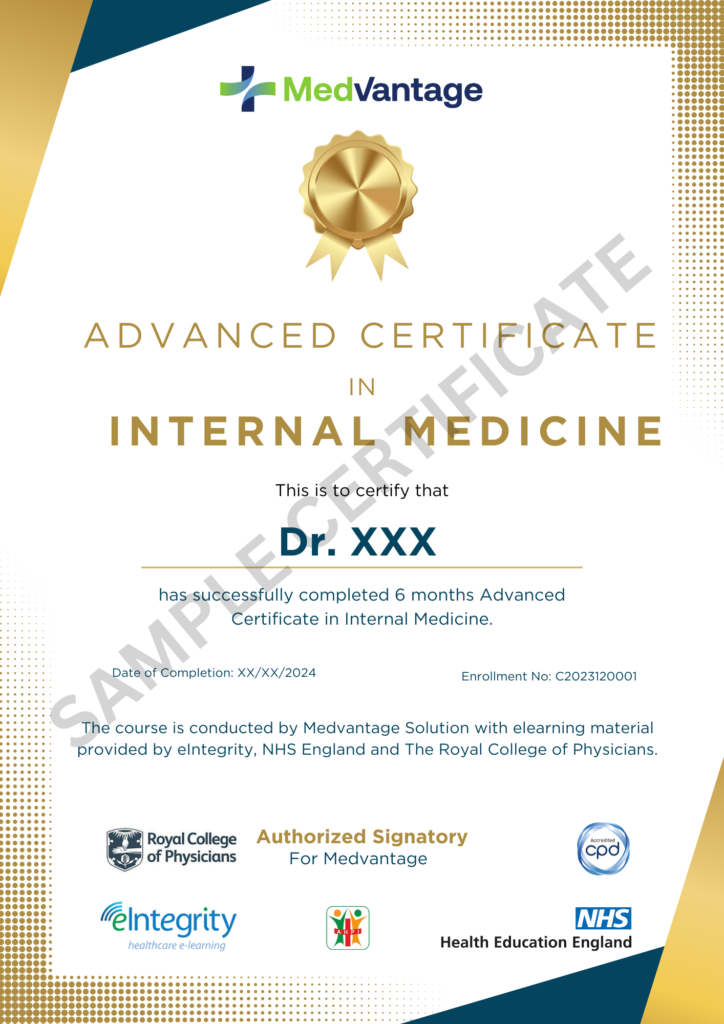
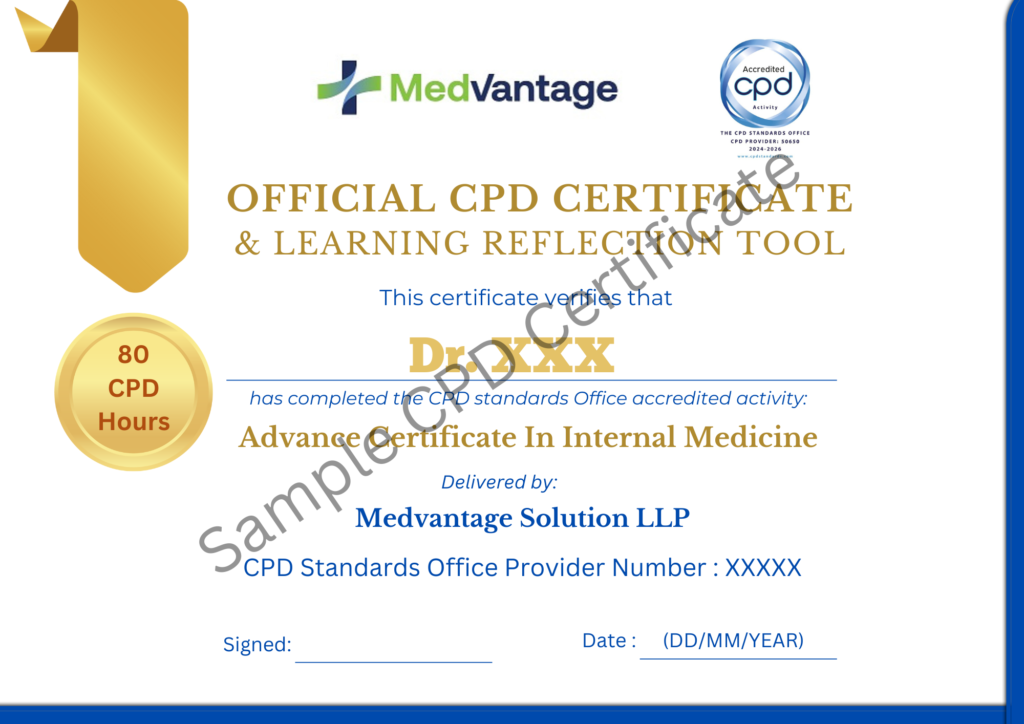
- Earn 80 CPD Points continuing medical education credits
- Digital certification with secure verification
- Share your achievement directly on LinkedIn and other platforms
- Certificate issued by MedVantage Education and recognized industry partners