


Eligibility Criteria
- MBBS/BDS/AYUSH/Nursing & Other Healthcare Graduates
- Practicing Doctors
- MD And DNB Residents
- Undergraduate Medical Students In The Final Year

Dr. D Peeyuusha
MBBS, MEM, MBA (Hospital Administration)
Consultant Emergency Physician Max Super Speciality Hospital, Noida Sec-128
Certificate in Critical Care
The Indian healthcare system faces a severe shortage of critical care doctors with expertise in running Intensive Care Units (ICUs) in hospitals. This shortage has become more acute with the increasing burden of critical illnesses and complex medical conditions. Our Certificate In Critical Care helps medical professionals reduce this gap.
- 3 Months
- Sep 28, 2026
- 23 modules
- 40 CPD Points
- Mode - Online
Course Curriculum
1. Critical Care Fundamentals:
- Introduction
- History of Critical Care
- Patient Evaluation and Assessment
2. Basic Sciences For Critical Care
- Anatomy Essentials – 1
- Anatomy Essentials – 2
- Anatomy Essentials – 3
- Physiology essentials – 1
- Physiology essentials – 2
- Physiology essentials – 3
- Physiology essentials – 4
- Physiology essentials -5
- Physics essentials – 1
- Physics essentials – 2
3. Equipments Used In Critical Care
- Medical Gas Supplies
- Gas and Vapour Controls
- Breathing System Components
- Common Breathing Systems
- Principles of Invasive Positive Pressure Ventilation (IPPV)
- Ventilator Settings and Alarms
- Filters, Humidifiers and Scavenging Systems
4. Monitoring in the ICU
- Basic Monitoring: ECG, SpO2 and Blood Pressure
- Gas Monitoring: O2, CO2, and Anaesthetic Agents
- Nerve Stimulators and Temperature Monitoring
5. Preoperative Equipment Check In ICU
- Checking the Anaesthetic Machine
- Checking Other Equipments
- Common Equipment Problems
6. Preoperative Assessment and Management In ICU
- General Preoperative Measures
- The Purpose of Preoperative Visiting
- Assessment Of A Difficult Airway
- ASA Grading and Preoperative Investigations
- Risk and Consent
7. Common Critical Care Conditions
- Assess Patients With Cardiovascular Or Respiratory Diseases
- Identify Problems Posed By Obese & Diabetic Patients
- Identify Risks Posed By Extremes Of Age & Emergency Surgery
8. The Operating Theatre Environment
- Principles Of Safe Practice & Role Of Anaesthetist
- Preparation And Usage of Equipment & Drugs
- General Theatre Conduct
- Medicines Safety In Anaesthetic Practice
9. Induction Of Anaesthesia & Intraoperative Management
- Aims of Anaesthesia
- Basic Principles Of Sedation
- Types of Anaesthesia
10. Management of Airway & Failed Intubation Drills
- Airway Maintenance: Facemask
- The Classic Laryngeal Mask Airway
- Basics of Tracheal Tube – 1
- Basics of Tracheal Tube – 2
- Recognizing Clinical signs & Management of Airway Obstruction
- Recognizing Clinical signs & Management of Difficult Airway
11. Induction of Anaesthesia
- How To Identify The Appropriate Sites for Induction
- Choice of Airway
- Importance of Pre-oxygenation
- Stages of Unconsciousness in Patients
12. Basic Techniques in General Anaesthesia
- Spontaneous Ventilation with Laryngeal Mask Airway (LMA)
- Ventilation with an Endo Trachial Tube (ETT)
- Indications for Rapid Sequence Induction (RSI)
13. Drugs Used in ICU
- Pre medication
- Intravenous Induction Agents
- Inhalational Anaesthetic Agents
- Perioperative Analgesia
- Neuromuscular Blocking Agents
- Local Anaesthetic Agents
- Drugs Used in an Emergency
Tab Title
Lorem ipsum dolor sit amet, consectetur adipisicing elit. Optio, neque qui velit. Magni dolorum quidem ipsam eligendi, totam, facilis laudantium cum accusamus ullam voluptatibus commodi numquam, error, est. Ea, consequatur.
14. Maintenance of Anaesthesia
- Maintenance of Anaesthesia and Avoiding Awareness
- Drugs used during Maintenance
- Ventilation During Maintenance: Spontaneous or Mechanical
- Monitoring, Vigilance for Untoward Events and Patient Positioning
- Identify Haemorrhage and Hypovolaemia
15. Postoperative Management
- Reversal and Extubation of Patients
- Management of Slow and Failed Recovery
- Transferring the Patient to Recovery
16. Post-Operative Recovery
- Overview of Recovery
- Airway maintenance and oxygen therapy
- How To Assess Post-Operative Pain
- Ward Visit after Major Surgery
17. Critical Incidents and Resuscitation
- Identify Signs that Indicate Developing Respiratory Problems
- Identify & How to Treat Intraoperative Hypotension, Hypertension
- Bradycardia & Tachycardia
- Recognise & Treatment of Anaphylaxis
- Management of Perioperative Arrest
18. Advanced Life Support
- Principles of Advanced Life Support
19. Principles of Critical Care Management – IV Cannulization
- IV Cannula Insertion
- IV Cannula Removal
- Central Line Insertion
- Central Line Removal
- Arterial Catheterization
- Pulmonary Artery Catheterization
- Urinary Catheterization
20. Mechanical Ventilation and Respiratory Support
- Chest Tube Insertion
- Chest Tube Removal
21. Cardiovascular Support and Arrhythmia Management
- Basic Principles of ECG
- Artificial Cardiac Pacemakers
22. Renal and Metabolic Support in Critical Care
- Electrolyte Disturbances In Critical Illness
- Respiratory Alkalosis
- Nutritional Support In The Intensive Care Unit
23. Central Nervous System
- Lumbar Puncture
Earn Recognized Certifications
Upon successful completion of the course and all required assessments, participants will be awarded professional certificates that are recognized by leading healthcare institutions.
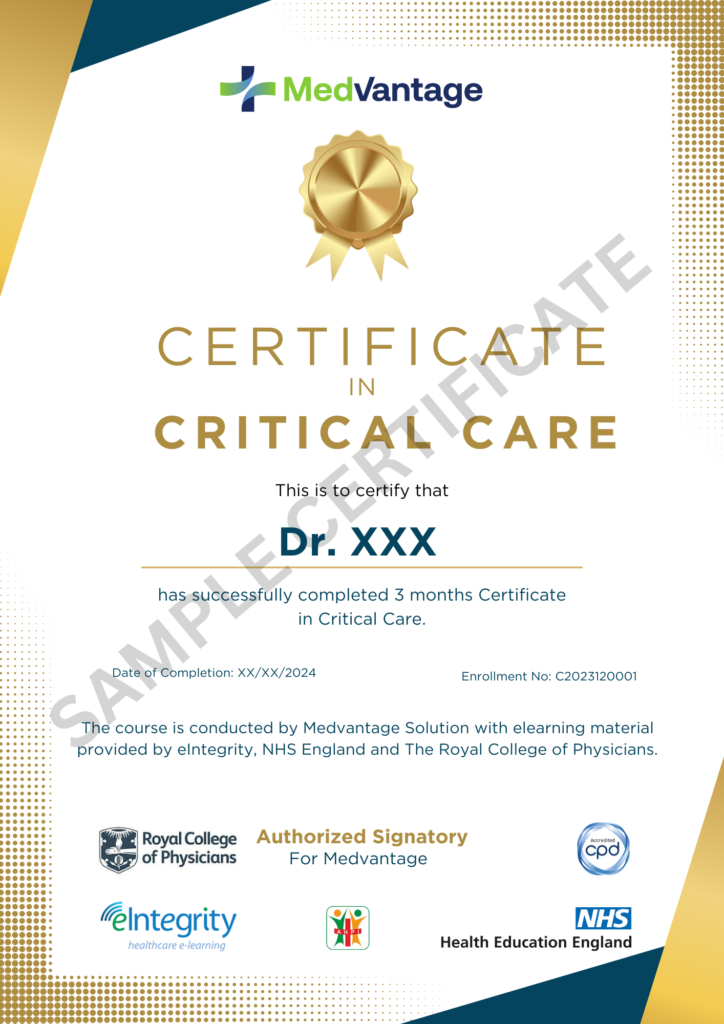
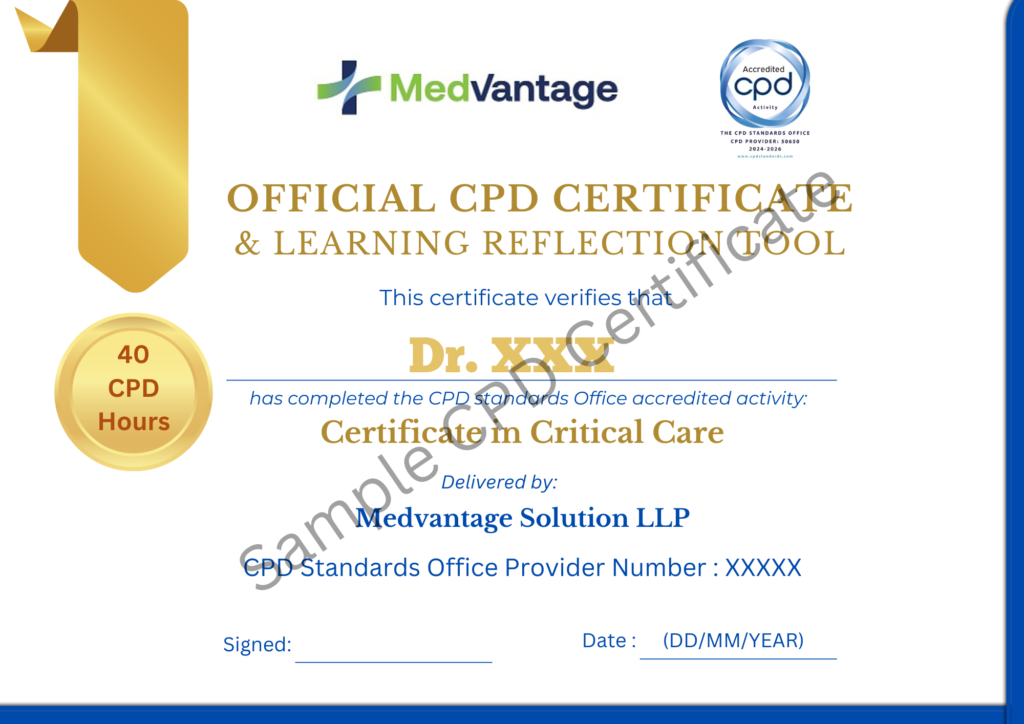
- Earn 120 CPD Points continuing medical education credits
- Digital certification with secure verification
- Share your achievement directly on LinkedIn and other platforms
- Certificate issued by MedVantage Education and recognized industry partners