

Executive MBA in Healthcare Management
Our mission is to cultivate a generation of healthcare managers who are ambitious, collaborative and willing to challenge existing norms to push innovation in healthcare. By integrating business acumen with cutting-edge healthcare management practices, this MBA equips you to navigate complex challenges and drive impactful change.
- 12months
- April 1, 2026
- 6 modules
Course Curriculum
1. Organizational Behaviour and Healthcare Organization
Module Aims
The aim of this module is to develop the understanding of organisational behaviour, when applied to a variety of healthcare settings, with a focus on structural and cultural environments.
Module Summary
This first module sets the foundations of Organisational Behaviour within the context of healthcare. Its focus on organisational theories and concepts is to build a greater critical understanding of prominent aspects of organisational theory and structure, the social organisation and multidisciplinary teams, and the importance of culture and motivating others.
Indicative content:
Introduction to Organisational Behaviour
What is an ‘Organisation’?
The Social Healthcare Organisation
Organisational Cultures in Healthcare
Motivational Theory
Human Resources
Learning Outcomes
Demonstrate a critical awareness of organisational behaviours and issues in healthcare organisations informed by relevant research and novel practice in the field.
Build an understanding of criticality and reflexivity in applying academic theories and concepts into practice.
Demonstrate originality, insight and critical/reflective practice to solve problems and create innovative propositions related to organisational behaviours.
Use systematic and creative approaches to address complex issues related to organisational behaviours, including undertaking critical thinking and reflective practice to provide confident judgement and apply appropriate courses of action.
Develop skills to contribute to evidence-based decision making in order to influence organisational outcomes.
2. Leadership in Healthcare
Module Aims
The overall aim of this module is to consider the different paradigms and approaches to leadership. Critically exploring the historical ‘heroic’ theories, building to the importance of collaborative and systems leadership, and applying these differing leadership perspectives of person, position and process into healthcare practice, will allow exploration and improved knowledge in leading healthcare challenges.
Module Summary
The module will delve deeper into what leadership means, exploring leadership theories to support greater critical thinking in considering what leadership means in supporting a more sustainable healthcare organisation.
Indicative content:
Leadership versus Management
Leadercentric’ Theories
Followership: the other side of leadership
Person, Position, Process, Product: collaborative leadership theories
Power and Leadership
Leadership challenges in Healthcare (Adaptive Leadership)
Learning Outcomes
On successful completion of the module, students will be able to:
Develop a critical understanding of what leadership theories mean in practice and applied in context, with a focus on the impending complex challenges facing healthcare systems.
Building on the traditional leadership theories of the ‘person,’ critically evaluate the more advanced theoretical frameworks considering leadership as a ‘process’, recognition and insights will be shared as to why leading collaboratively has the potential to critically develop more systematic responses in suggesting new ideas to unpredictable healthcare leadership challenges.
Building on personal experiences in leadership, apply learning to develop advanced interpersonal, team and networking skills to strategically enhance collaboration across organisational boundaries to address complex situations and contribute to the field of healthcare leadership with greater confidence.
3. Strategy and Healthcare
Module Aims
The module aims to develop a systematic understanding and critical application of strategic management to ensure a responsible yet innovative and sustainable approach within the complex context of healthcare.
Module Summary
The module builds on the foundations of strategic management thinking to further develop understanding of strategy which supports innovation in healthcare. This is undertaken by exploring, critically and reflectively, contemporary approaches to enable appropriate and informed strategic decisions with a focus on sustainable development.
Indicative content:
What is Strategy? Exploration of various definitions
Models and frameworks: which are relevant in healthcare?
Stakeholders and power mapping
Contemporary issues in strategic thinking
Strategic focus on sustainability and the future of healthcare
Healthcare in 2050: a discussion
Learning Outcomes
Apply a systematic understanding of strategic management, to develop a high level of critical thinking to understand the value of strategy and innovation for the future of healthcare.
Select advanced principles and theoretical frameworks in strategic management to critically develop systematic responses to explore and develop sustainable innovation for the future of healthcare.
Practically explore and apply strategic thinking and innovate for the future, working with stakeholders to address the complex needs and increased demands on healthcare organisations.
4. Understanding in Financial Management
Module Aims
This module aims to develop students’ understanding and interpretation of financial management in healthcare, to make more informed decisions to influence and assist the impact of this function on the principles and practices of healthcare management decision making.
Module Summary
To introduce and support a more comprehensive understanding of financial management in healthcare, along with being able to better interpret and apply financial statements, budgeting, costing and investment appraisal in financial and business decision making.
Indicative content:
Introduction to financial terminology for the service sector
Management accounting in decision making
Sources of healthcare finance
Budgeting and budgetary control
The role and use of different financial statements
Financial challenges in healthcare – discussion
Learning Outcomes
Recognition and understanding of financial management at a local level to be more effective and efficient in providing high quality care to patients and other service users.
Systematically analyse incomplete and/or contradictory evidence, to be better informed at influencing financial planning and contribute realistic recommendations to improve financial sustainability.
Develop skills and knowledge to systematically organise and communicate advanced financial management to effectively and confidently use financial data to better inform healthcare stakeholders in unpredictable and complex contexts.
5. Marketing in Healthcare Organization
Module Aims
The aim of this module considers the traditional philosophies and processes of marketing, then critically applies what it means in healthcare organisations – public and private. Analysing and developing a comprehensive understanding as to how marketing in the service sector of healthcare is potentially more about communication and setting expectations, the importance of ethics will also be explored in recognition of the expanse of stakeholders, departments and specialisms.
Module Summary
This module is designed to challenge the traditional concept of marketing to critically analyse what it means to communicate with stakeholders across healthcare organisations, exploring what is meant by a communication strategy and what is involved in better engaging the public.
Indicative content:
What is marketing? Philosophy or Process?
Marketing in the healthcare context: Ethics and Expectations
‘Consumers’ and evaluating the market
Developing communication and marketing strategies in healthcare
Social-media in marketing – audience and ethics
Organising, implementing and controlling marketing in healthcare
Learning Outcomes
Consider the importance of developing and delivering a comprehensive marketing strategy, analysing the impact and ethics on the diverse mix of stakeholders.
Build on experience and skills to critically explore how marketing frameworks can be adapted to influence internal and external communications in healthcare organisations.
Through research and discussing practical experiences, hone skills to think how marketing and communication can be better targeted to influence the required audience via the appropriate media, using the appropriate language to communicate during unpredictable healthcare management situations.
6. Managing Change in Healthcare Services
Module Aims
This module aims to explore how to effectively manage and lead change within complex healthcare organisations. Taking into account some of the traditional change management theories, these will then be critically applied in addressing the inhibitors to change, along with gaining insights into some of the important drivers for change. These include why is the ‘change’ necessary’, change in line with quality improvement (especially in line with patient/user safety) and the importance of Equality, Diversity and Inclusivity.
Module Summary
This module will cover the more popular models and theories of change management, while systematically being encouraged to critically evaluate their practice and process of applying them in healthcare organisations, whilst addressing the challenges of effective long term change.
Indicative content:
Change Management theories
What are the inhibitors to change?
Drivers for change: Why change?
Drivers for change: Clinical Governance
Drivers for change: Patient safety and quality improvement
Drivers for change: Diversity and Inclusivity
Learning Outcomes
Appraise the impact of a variety of organisational change theories, recognising why change can be so complex in the context of prevailing social, economic and health care systems.
Critically apply theories and practical examples to evaluate methods of leading effective and relevant change to benefit the future of healthcare.
By considering why change is necessary and what inhibits change, critically discuss effective techniques in line with how to influence and drive complex and innovative change in healthcare.
Earn Recognized Certifications
Upon successful completion of the course and all required assessments, participants will be awarded professional certificates that are recognized by leading healthcare institutions.
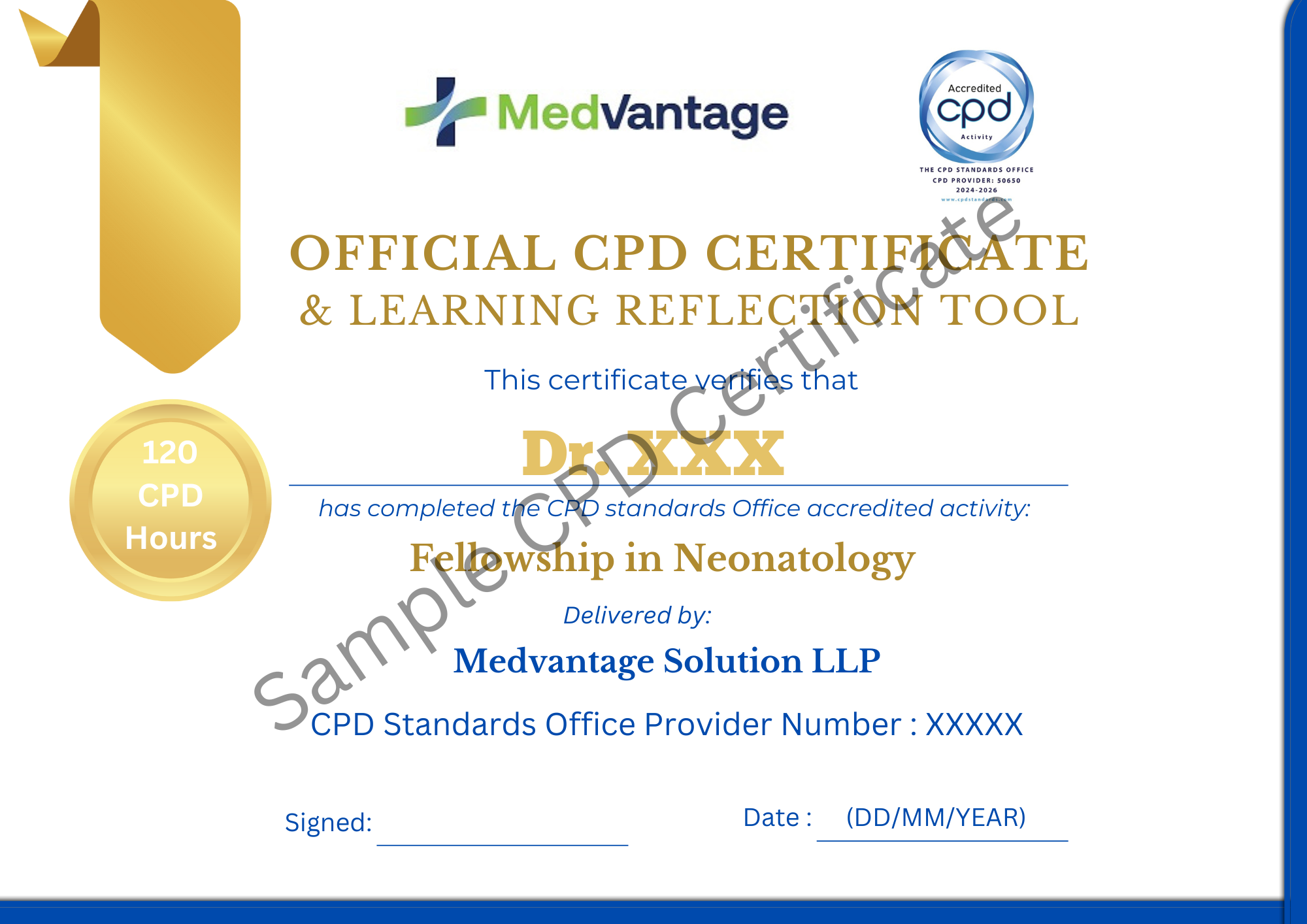
- Professional development and continuing education
- Digital certification with secure verification
- Share your achievement directly on LinkedIn and other platforms
- Certificate issued by MedVantage Education and recognized industry partners

Category
Fellowship
Duration
12months
Mode
Online
Eligibility Criteria
- Our online Executive MBA in Healthcare Management course is for management-level students who want to advance their leadership, industry and management skills.
Expert Instructor
Course Instructor
Experienced professional with expertise in the subject matter. Course Mentor/Faculty