

Eligibility Criteria
- MBBS Graduates
- Practicing Doctors (MBBS+MD/MS/M.Ch)
- MBBS+MD And DNB Residents
- Undergraduate Medical Students In The Final Year

Dr. D Peeyuusha
MBBS, MEM, MBA (Hospital Administration)
Consultant Emergency Physician Max Super Speciality Hospital, Noida Sec-128
Fellowship in Intensive Care Medicine
Fellowship in Intensive Care Medicine prepares practitioners for high-tech, resource-intensive medical settings like ERs, ICUs, and disasters. It focuses on specialized care for critically ill patients, covering diverse physiological support methods. Led by experts, it aims for efficient, quality care, impacting patient outcomes positively. The program also offers hands-on experience in a corporate hospital
- 12 Months
- Sep 25, 2026
- 9 modules
- 120 CPD Points
- Mode - Hybrid
- Observership - 1 Month
Course Curriculum
1. Anesthesia and Emergency Medicine(ICM)
- The Anaesthetist and the Theatre Team
- Preparation and Usage of Equipment and Drugs
- General Theatre Conduct
- Medicines Safety in Anesthetic Practice
2. General Concepts of ICM
• An introduction to Critical Care.
• Identification of the Critically Ill patient.
• Organ Support.
• Nutrition and fluid therapy.
• Analgesia and Sedation.
• The costs and unwanted effects of critical care
• End of Life Care.
• Transfer Medicine
3. Medicine and Surgery for ICM
• Cardiology
• Endocrinology
• Gastrointestinal
• Hematology
• Immunology
• Neurology
• Obstetrics
• Pediatrics
• Perioperative medicine
• Psychiatry
• Renal
• Respiratory
• Toxicology
• Vascular
• Rheumatology
• Dermatology
4. Infectious Disease in ICM
• Common pathogens.
• Infectious Diseases.
• Sepsis.
• Treatment and control of infection
5. TRAUMA
• Major Incidents.
• Trauma Resuscitation.
• Traumatic Injuries
6. Procedures, Monitoring, and Investigations in ICM
Procedures – • Microbiological sampling.
• Vascular Access.
• Percutaneous tracheostomy.
• Chest drainage.
• Bronchoscopy.
• Nasogastric Tube Insertion.
• Urinary Catheterization
Investigations- • EEG.
• ECG.
• Bedside Echocardiography.
• CXR.
• CT Chest.
• Abdominal XR.
• CT Abdomen / Pelvis.
• CT Head.
• MRI.
• Pulmonary Function Tests.
• Biochemistry and Hematology
Monitoring-• General principles.
• Cardiovascular.
• Neurological.
• Respiratory
7. Patient Safety in ICM
First do no harm – Safe Prescribing
• Prescribing Safely in Pregnancy.
• Safe Prescribing in Renal Impairment.
• Safe Prescribing of Insulin
Maintaining a safe environment
Critical Incidents and Emergencies
Emergency Cardiac Procedures
Airway emergencies – • Tracheostomy 1: Basic Knowledge about Tracheostomies and Laryngectomies.
• Tracheostomy 2: Emergency Management of a Tracheostomy or Laryngectomy.
• Management of Unanticipated Difficult Intubation in Adults: Not Just Another Algorithm
Anaphylaxis
Cardiac arrest – • Management of cardiac arrest following cardiac surgery.
• Prognostication of patients after cardiopulmonary resuscitation.
• Current recommendations on adult resuscitation.
• Current recommendations for paediatric resuscitation
8. Non-clinical Topics for ICM
• Research and Audit.
• Clinical Governance.
• Non-Technical Skills.
• The laws
• Ethics
9. Self-assessment (Multiple-Choice Questions)
- No Content
Earn Recognized Certifications
Upon successful completion of the course and all required assessments, participants will be awarded professional certificates that are recognized by leading healthcare institutions.
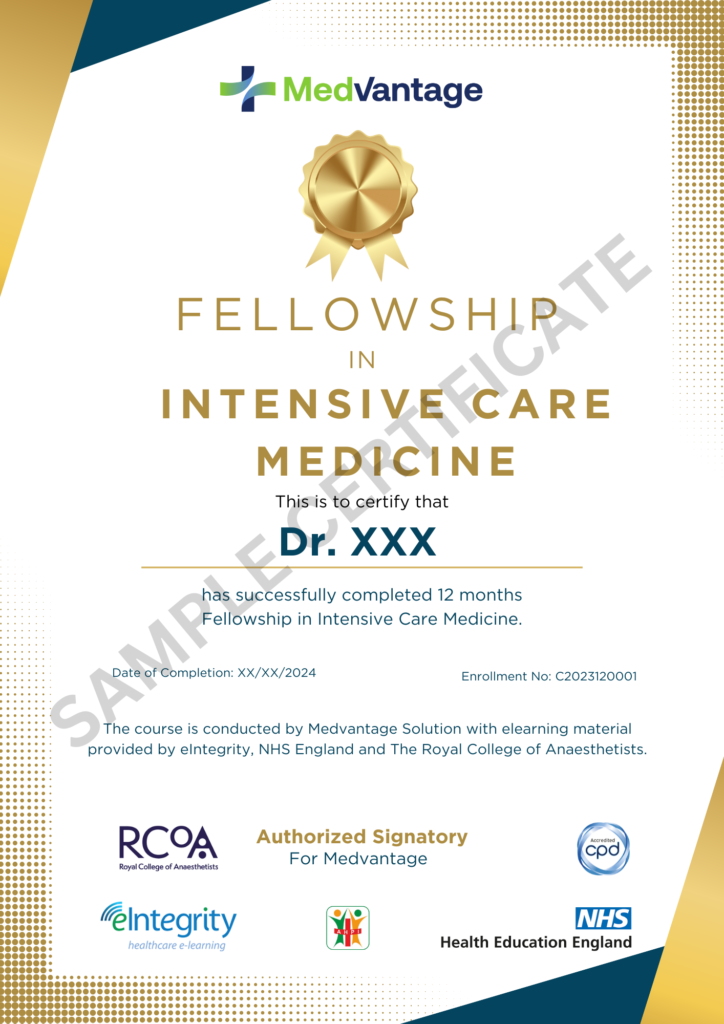
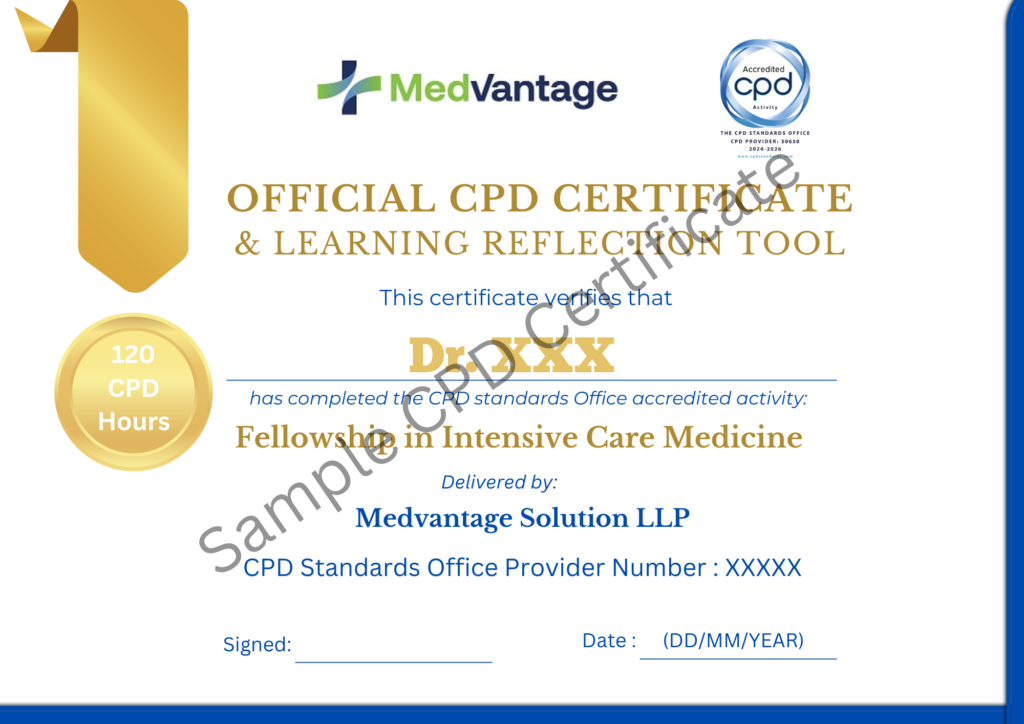
- Earn 120 CPD Points continuing medical education credits
- Digital certification with secure verification
- Share your achievement directly on LinkedIn and other platforms
- Certificate issued by MedVantage Education and recognized industry partners
Frequently Asked Questions
What is the duration of Fellowship in Intensive Care Medicine by Medvantage
The Fellowship in Intensive Care Medicine by MedVantage is a 12-month hybrid program designed for working medical professionals. The course includes 9 comprehensive learning modules, 120 CPD points, and 1 month of clinical observership at a reputed hospital, providing a balanced blend of online academic learning and clinical exposure.
What is the eligibility to enroll in the Fellowship in Intensive Care Medicine?
The Fellowship in Intensive Care Medicine by Medvantage is open to healthcare professionals at different stages of their medical careers. You are eligible to enroll if you are:
- MBBS Graduate
- Practicing Doctor (MBBS, MD/MS/M.Ch)
- MD or DNB Resident
- Final-Year MBBS Student
Can I persue this course if I am in final year?
YES, this course can be taken up by final year, graduated & post graduate students.
What’s the importance of this course in India?
You will get additional qualification Certificate (United Kingdom) which will benefit you in increasing the number of patients in OPD.
How many CPD hours are accredited on completion of the Fellowship in Intensive Care Medicine?
Upon the successful completion of the Fellowship in Intensive Care Medicine, participants are awarded 120 CPD (Continuing Professional Development) hours by the CPD Standards Office, United Kingdom.
Can I pursue the course if I’m working in govt. hospital?
YES, it’s an online course, you can attend classes at any time as per your schedule.
Can I apply if my FMGE is not clear?
YES, you can apply, but by end of the course we need your MCI registration certificate.
In which form, I will get the study material?
In form of modules which includes Live Class with Course Mentor, Recorded Lectures, Webinars and PDFs.
Can international students enroll in the Fellowship in Intensive Care Medicine?
Yes. International students are welcome to enroll in the Fellowship in Intensive Care Medicine by Medvantage, subject to meeting the program's eligibility criteria and submission of the required academic and professional documents.